



Turning 70 does not rule out dental implants. Many people choose dental implant after 70 to replace missing teeth and improve oral health. Age alone rarely decides your outcome.
Dentists focus on your overall health, jawbone strength, and gum condition before they recommend dental implants for seniors.
They review your medical history, check for gum disease, and study bone density with X-rays or scans. They also look at how well you can heal and maintain dental implants.
When you understand what your dentist evaluates, you can feel more confident about your choices. You can also prepare for questions about healing time, risks, and long-term care.
Key Takeaways
- Your overall health and bone support matter more than your age.
- Healthy gums and strong jawbone improve implant success.
- Good daily care and follow-up visits protect long-term results.
Determining Eligibility for Dental Implants in Older Adults
Age alone does not decide if you qualify for implants. Your dentist looks closely at your health, medications, and daily habits before recommending treatment.
Health Factors That Matter Most
You are not automatically too old for dental implants. Dentists focus on your overall health, not your birth year. Many experts explain that your general health matters more than age when deciding on implants.
During a dental implant consultation, your dental surgeon checks:
- Bone density and volume
- Signs of gum disease
- Bite strength and chewing ability
- Healing capacity
Healthy gums and enough jawbone help the implant bond with bone. If bone loss has occurred, your oral surgeon may suggest bone grafting before placing the implant.
Dentists also review how well you recover from past dental work. Slow healing or repeated infections may change the treatment plan.
Medical Conditions and Medications
Certain medical issues affect implant safety. Research on medical considerations in the ageing implant patient shows that conditions like diabetes, heart disease, and osteoporosis can raise the risk of problems if not well controlled.
Your dentist will ask about:
- Diabetes control and blood sugar levels
- History of radiation to the jaw
- Heart conditions or recent cardiac events
- Bleeding disorders
Medications also matter. Blood thinners, antiplatelet drugs, and some bone-strengthening drugs can affect surgery and healing.
This does not mean implants are unsafe. Many reports confirm that dental implants are safe for older adults when a trained dental surgeon plans treatment carefully.
Your implant consultation may include contact with your physician to adjust timing or medications before surgery.
Lifestyle Habits and Oral Hygiene
Your daily habits play a large role in long-term success.
Smoking slows healing and raises the risk of implant failure. Poor oral hygiene can lead to plaque buildup and gum disease, which can damage the tissue around an implant.
Dentists assess:
- How often you brush and floss
- If you attend regular cleanings
- Your ability to clean around implants
Arthritis or limited hand strength can make brushing harder. Your oral surgeon may suggest special brushes or more frequent cleanings to protect your oral health.
Strong oral hygiene supports healthy gums, stable implants, and better chewing ability for years to come.
Evaluating Jawbone and Gum Health Before Treatment
Your dentist looks closely at your jawbone and gum tissue before placing implants. Strong bone and healthy gums give the implant a stable base and lower your risk of problems later.
Bone Density and Jaw Health Assessment
Your implant needs solid bone to stay secure. Dentists check your bone density and the amount of bone in the area where the tooth is missing.
When you lose a tooth, the jawbone in that spot can shrink over time. This bone loss can affect how well an implant bonds to your jawbone.
Dentists measure the height and width of the bone to see if it can support the implant safely.
If the bone is too thin or soft, you may need extra treatment first. Some patients benefit from bone grafting to rebuild lost bone.
Others may need a sinus lift if the upper back jaw sits too close to the sinus cavity.
These steps help preserve jawbone strength and create a stable base. As explained in this guide on preoperative dental implant site evaluation, careful bone assessment plays a key role in long-term implant success.
Gum Health and Periodontal Disease
Healthy gums protect the bone around your implant. Your dentist checks for signs of swelling, bleeding, or deep pockets around your teeth.
Active periodontal disease can damage both gum tissue and bone. If you have untreated gum disease, the infection can increase the risk of implant failure.
Dentists often measure pocket depth and review your history of gum problems.
If gum disease is present, you may need treatment before moving forward. This can include deep cleaning or other periodontal care to restore gum health.
Age alone does not stop you from getting implants. Dentists focus more on your overall oral condition, including healthy gums and bone support.
Advanced Imaging and Diagnostic Tools
Dentists rely on detailed images to plan your treatment. Standard X-rays give a basic view, but many offices now use CBCT imaging for a 3D scan of your jawbone.
CBCT scans show bone thickness, density, and the exact location of nerves and sinuses. This helps your dentist choose the right implant size and position.
It also reduces the risk of placing an implant too close to a nerve or sinus cavity.
These scans help your dentist decide if you need procedures like bone grafting or sinus lifts before implant placement.
Clear imaging supports better planning and protects your long-term bone health.
Types of Dental Implants and Replacement Options
When you lose one tooth or many teeth, dentists can use different dental implants to rebuild your smile.
The right option depends on how many teeth you lost, how strong your jawbone is, and how much stability you want compared to traditional dentures.
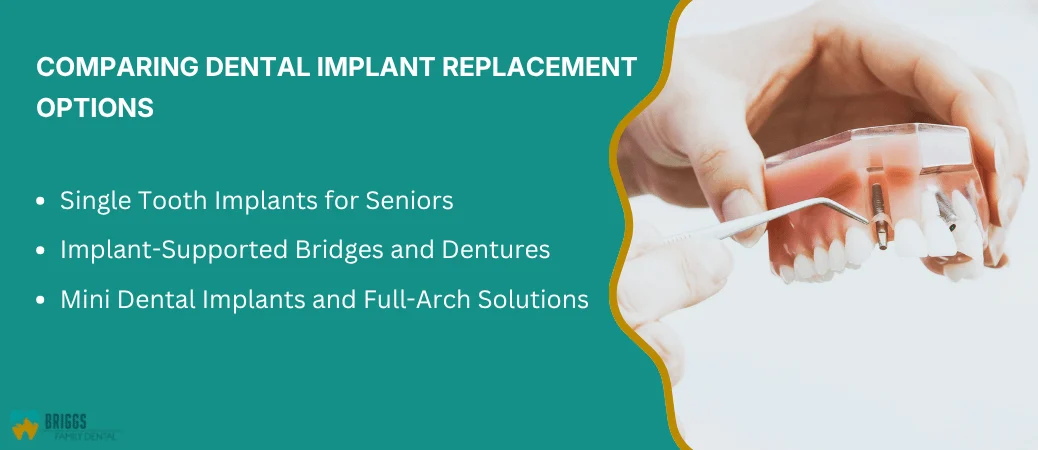
Single Tooth Implants for Seniors
If you lost one tooth, a single tooth implant often works well. Your dentist places a small titanium post into your jaw. This post acts as an artificial tooth root and supports a custom crown.
A single tooth implant stands on its own. Your dentist does not need to grind down nearby teeth, which protects your natural tooth structure.
Many dentists note that dental implants for seniors have high long-term success rates.
You need enough healthy bone to hold the implant. If your bone is thin, your dentist may discuss bone grafting before treatment.
Implant-Supported Bridges and Dentures
If you lost several teeth in a row, your dentist may suggest an implant-supported bridge. Instead of placing one implant for every missing tooth, they place two or more implants to support a row of replacement teeth.
This option spreads pressure across the implants. It often feels more secure than a removable partial denture.
For full tooth loss, implant-supported dentures can replace all teeth in your upper or lower jaw. These dentures snap onto implants and stay in place while you eat and speak.
Compared to traditional dentures, implant-supported dentures:
- Move less during meals
- Help you chew tougher foods
- Reduce pressure on your gums
- May help limit further jawbone loss
You still remove some designs for cleaning, while others stay fixed in place. Your dentist will review which type fits your health and daily routine.
Mini Dental Implants and Full-Arch Solutions
Mini dental implants are thinner than standard implants. Dentists may use them when your jawbone lacks width or when you cannot have extensive surgery.
Mini implants often stabilize lower dentures. The procedure may be shorter and less invasive, but they may not suit every case of tooth loss.
For complete tooth replacement, some dentists use full-arch solutions with four or more implants to support a full set of teeth. These systems anchor a fixed bridge to several implants, giving you a stable bite.
During your exam, your dentist checks:
- Bone height and density
- Gum health
- Medical conditions like diabetes
- Smoking history
Your overall health and bone quality matter more than your age. Careful planning helps you choose the safest and most stable tooth replacement option for your needs.
Understanding the Dental Implant Procedure and Healing Process
Getting a dental implant takes time and careful planning. You move through clear stages, from evaluation to healing, with each step designed to protect your health and improve your chewing ability and speech.
Consultation and Treatment Planning
Your dental implant consultation sets the foundation for the entire dental implant process. Your dentist reviews your medical history, current medications, and any conditions that may affect healing, such as diabetes or heart disease.
You will receive a full oral exam. This often includes X-rays or 3D scans to check bone height, bone density, and the position of nerves and sinuses.
Your dentist also checks your gums for infection and signs of gum disease. If your bone is too thin or soft, you may need a bone graft before implant surgery.
You will discuss:
- The number of implants needed
- The type of restoration (fixed or removable)
- Healing time and follow-up visits
- Costs and anesthesia options
Clear planning reduces risks and helps you know what to expect.
Implant Surgery and Placement
Dental implant surgery usually happens in stages. Most procedures take place in an outpatient setting with local anesthesia, sedation, or both.
During implant surgery, your dentist makes a small cut in the gum to expose the bone. They then place a titanium post into the jaw. This post acts as the new tooth root.
If you need bone grafting, your dentist may complete it before or during this visit. The condition of your jawbone determines the approach.
After placement, you may have:
- Mild swelling
- Minor bleeding
- Soreness for a few days
You may receive a temporary denture to protect the area and maintain appearance while healing begins.
Abutment Attachment and Final Restoration

Once the implant bonds with your bone, your dentist attaches the abutment. The abutment is a small connector that links the implant to your new crown.
In some cases, your dentist places the abutment during the initial dental implant surgery. In other cases, they wait until healing progresses.
After the gum heals around the abutment, your dentist takes impressions of your mouth. A lab then creates a custom crown that matches your other teeth in shape and color.
You can choose between:
- Fixed crowns, which stay in place
- Removable implant-supported dentures, which snap on and off
A properly fitted crown supports clearer speech and stronger chewing ability. It should feel stable and natural when you bite.
Recovery, Osseointegration, and Maintenance
Healing takes patience. The most important stage is osseointegration, when your jawbone fuses to the implant.
In older adults, early gum healing often takes about one to two weeks. Full bone fusion usually takes three to six months.
During recovery, you should:
- Eat soft foods
- Avoid smoking
- Keep the area clean
- Take prescribed medications
Good oral hygiene is critical. Brush gently, clean around the implant daily, and attend regular dental check-ups.
With proper care, implants can remain stable for many years and help you maintain comfort, function, and confidence.
Benefits, Risks, and Long-Term Care for Seniors
Dental implants can improve how you eat, speak, and care for your mouth. At the same time, you need to understand healing time, possible risks, and the daily care required to protect your investment.
Key Advantages of Dental Implants
Dental implants replace missing teeth with a fixed solution that feels stable. You can chew more evenly, which helps you eat fruits, vegetables, and proteins that support good oral health and overall health.
Unlike removable dentures, implants do not shift when you talk or laugh. Many seniors prefer implant-supported dentures because they snap into place and stay secure throughout the day.
Implants also help protect your jawbone. When you lose a tooth, the bone in that area can shrink. An implant places a titanium post in the bone, which helps maintain bone structure and support nearby teeth.
You may also notice:
- Better comfort compared to loose dentures
- Improved gum health when you can clean around each tooth
- No need to grind down nearby teeth, as with some bridges
These benefits of dental implants often make daily life easier and more predictable.
Longevity and Success Rates in Older Patients

Many older adults worry that age alone lowers success rates. Research shows that age by itself does not prevent good results.
Dental implants show about a 97% success rate at 10 years and about 75% at 20 years. A 2019 study comparing adults over 65 with younger patients found similar failure rates over 10 years.
Your long-term results depend more on:
- Bone quality
- Gum health
- Medical conditions such as diabetes
- Smoking habits
- Your commitment to oral hygiene and dental check-ups
When you control these factors, implants can last for many years.
Potential Risks and Complications
Every surgery carries some risk. With dental implants, problems can occur during healing or years later.
Early risks include infection, swelling, or delayed healing. People with uncontrolled diabetes or those who smoke face higher infection risk and slower recovery.
Late complications may include:
- Loose screws
- Gum inflammation around the implant
- Bone loss if plaque builds up
- Implant failure in rare cases
Some adults over 80 show slightly higher complication rates, but age alone does not disqualify you. Your dentist will review your medical history, medications, and bone levels before recommending treatment.
Careful planning lowers risk and improves your outcome.
Tips for Maintaining Healthy Implants
You must care for implants every day. Good oral hygiene protects both the implant and your surrounding gum tissue.
Brush twice daily with a soft toothbrush. Clean around the implant using floss, a water flosser, or small interdental brushes. This reduces plaque that can irritate your gums.
Keep up with regular dental check-ups. Your dentist will:
- Check implant stability
- Measure gum health around the implant
- Take X-rays when needed
- Remove hardened plaque that brushing cannot remove
If you wear implant-supported dentures, remove and clean them as directed. Report any pain, looseness, or swelling right away.
With steady care and routine visits, you can protect your implants and support long-term oral health.
Frequently Asked Questions
Dentists look at your age, medical history, jawbone strength, and daily habits before they suggest implants.
They also review your medications, healing ability, and other tooth replacement options to make sure treatment is safe and likely to last.
Am I too old to get dental implants, and how do dentists decide?
Your age alone does not block you from getting implants. Many people in their 70s and even 80s qualify when they are in good health.
Your dentist checks your overall health, gum condition, and jawbone density. They also make sure you can keep up with daily brushing, flossing, and follow-up visits.
If your body can heal well and your mouth is healthy, age by itself is not a problem.
What health conditions or medications could affect whether I’m a good candidate for implants?
Certain health issues can affect healing after surgery. Uncontrolled diabetes, severe heart disease, or immune system problems may raise the risk of infection or implant failure.
Some medications, such as drugs that affect bone strength or blood clotting, may also change your treatment plan. Dentists review your full medical history before moving forward.
You may still qualify, but you might need medical clearance or closer monitoring.
How do dentists check if I have enough jawbone for implants, and what happens if I don’t?
Your dentist uses X-rays or 3D scans to measure the height and width of your jawbone. These images show if the bone is thick and strong enough to hold an implant.
If you do not have enough bone, bone grafting may rebuild the area. In some cases, you may need extra healing time before the implant is placed.
Delaying tooth replacement can lead to more bone loss, which can affect implant decisions.
What is the success rate of dental implants for seniors, and what factors influence it?
Dental implants often succeed in older adults when they are placed in healthy bone and cared for properly. Many seniors in their 70s have successful outcomes.
Your success depends on bone quality, gum health, and how well you control medical conditions. Smoking and poor oral hygiene can lower success rates.
Regular dental visits help your dentist spot problems early and protect your investment.
What does the “3-2 rule” for dental implants mean, and does it apply to me?
The “3-2 rule” often refers to placing three implants to support a bridge of two replacement teeth in certain cases. Dentists use this approach when they want to balance support and cost.
This rule does not apply to everyone. Your dentist designs your plan based on how many teeth you are missing, how much bone you have, and how much bite force your jaw creates.
You may need a single implant, several implants, or a full-arch solution instead.
What are the safest alternatives if implants aren’t recommended for me?
If implants are not a good fit, removable dentures or fixed bridges may replace missing teeth. These options cost less upfront and do not require surgery.
Dentures sit on top of your gums and may need adjustments over time. Bridges attach to nearby teeth and rely on their strength for support.
Your dentist will explain the pros and limits of each choice so you can pick what fits your health and goals.