




Losing teeth can feel like a big challenge, especially as you get older. But dental implants offer a strong, long-lasting way to replace missing teeth and improve your smile.
Dental implants are safe and effective for seniors, giving you a stable, natural-feeling solution that can last many years when cared for properly.
You might wonder if your age or health conditions make implants a poor choice. The good news is that many seniors, even those in their 70s, 80s, and beyond, successfully get implants.
What really matters is your overall health, bone quality, and how well you follow care instructions before and after the procedure.
If you want to enjoy better chewing, clearer speech, and a more confident smile, dental implants could be the right option. This guide will help you understand what to expect, how the process works, and how to decide if dental implants fit your needs.
Key Takeaways
- Dental implants provide a reliable and natural tooth replacement for seniors.
- Your health and bone condition are key to successful implant treatment.
- Proper care and understanding of the process help ensure long-term results.
Why Dental Implants Are Ideal for Seniors
Dental implants offer a strong and lasting way to replace missing teeth. They help keep your jaw healthy, improve how you eat, and look much like natural teeth.
Research shows that seniors experience five‑year dental implant survival rates of 96.8%, proving that dental implants can provide a reliable solution for older adults in the long term. Choosing implants can make daily life easier and more comfortable compared to other options.
Tooth Loss and Quality of Life
Losing teeth can affect many parts of your life. It may make eating certain foods difficult, leading to poor nutrition.
Missing teeth can also change how your face looks, causing a sunken appearance over time. This may lower your confidence and make speaking clearly harder.
With dental implants, you get back a stable and natural-feeling solution. Implants are fixed in your jawbone, so they don’t slip.
This means you can enjoy foods like apples or steak without worry. Restoring your smile with implants can also boost your confidence during social situations.
Dental Implants vs. Dentures
Traditional dentures are removable and can shift in your mouth. They often need adjustments and replacements, which can be inconvenient.
Dentures may cause sore spots or slipping while talking or eating, affecting your comfort.
Dental implants, however, are surgically placed and become part of your jaw. They don’t move or need frequent changes.
This stability helps you chew better and speak more clearly. Implants also protect your jawbone, unlike dentures, which can cause bone loss over time.
| Feature | Dental Implants | Dentures |
| Stability | Fixed in jawbone, secure | Removable, may slip |
| Bone Health | Preserves bone | Can lead to bone loss |
| Comfort | Feels like natural teeth | May cause irritation |
| Maintenance | Regular brushing, flossing | Requires removal, cleaning |
Benefits of Dental Implants for Seniors
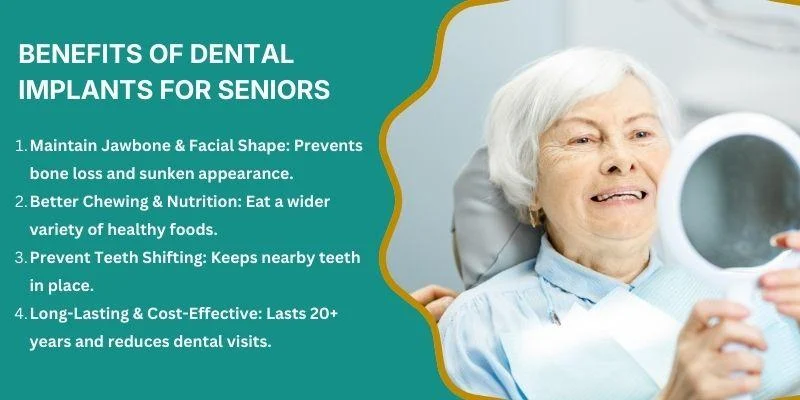
Dental implants bring several important benefits for seniors. They keep your jawbone strong, which helps maintain your facial shape.
This prevents the sunken look caused by missing teeth. Implants improve your chewing ability, letting you eat a wider variety of healthy foods.
This supports better nutrition and overall health. They can also stop nearby teeth from moving, which often happens with gaps left by missing teeth.
You’ll enjoy a long-term and cost-effective solution since implants usually last 20 years or more with proper care. Plus, implants look natural, helping you smile with confidence again.
Choosing implants means fewer dental visits compared to dentures, making life simpler and more comfortable.
How Dental Implants Work
Dental implants are a strong and lasting way to replace missing teeth. They restore your ability to chew and speak clearly while keeping your smile natural.
The process depends on parts that fit together and how your jawbone interacts with the implant.
Key Components: Implant Post, Abutment, and Crown
The implant has three main parts. First, the implant post is a small, titanium screw placed into your jawbone.
This acts like the root of a natural tooth. It is strong and designed to stay in place for many years.
Next is the abutment, a connector attached to the implant post. It holds the fake tooth safely onto the post.
Finally, the crown is the visible part of your new tooth. It looks and feels like a real tooth, matching the shape and color of your smile.
The crown is made from durable materials like ceramic or porcelain. Each part works together to provide a stable and comfortable tooth that functions just like your natural teeth.
Osseointegration and Jawbone Health
Osseointegration is a key process where your jawbone grows around the implant post. This “bonding” creates a strong hold that keeps the implant steady.
Without good osseointegration, the implant can loosen or fail. Your jawbone health is very important.
Bone can shrink if you lose teeth, but the implant helps keep it healthy by stimulating the bone. This stops bone loss and keeps your face looking fuller.
If your jawbone is weak or thin, your dentist might suggest a bone graft to build it up before placing the implant. This step helps ensure osseointegration happens well, making your implant last longer.
Ready to improve your smile and restore your confidence? Schedule a consultation with our experts today to explore how dental implants can work for you!
Candidacy and Preparation for Seniors
Getting ready for dental implants means paying close attention to your oral health and overall well-being. Your jawbone strength, gum condition, and general health all play big roles in whether implants will work well for you.
Meta‑analysis evidence suggests that the risk of implant loss in older adults is not significantly higher than in younger patients, supporting implants as a viable option with proper care.
Bone Density and Bone Loss Considerations
Your jawbone needs to be strong enough to support implants. Over time, missing teeth can cause bone loss, making it harder for implants to hold securely.
If you have significant bone loss, your dentist might suggest bone grafting to rebuild the area. Bone grafting adds bone material to your jaw, helping create a solid base for implants.
Sometimes, mini dental implants are an option if bone density is low but still enough for small implants. Your dentist will use X-rays or 3D scans to check your bone health before treatment.
This helps plan the best approach to give you stable and lasting implants.
Evaluating Gum Disease and Oral Hygiene
Healthy gums are just as important as strong bone. If you have gum disease, it can cause inflammation and damage that may harm implants.
Your dentist will thoroughly check your gums for any signs of infection or disease. Before implants, any gum disease needs to be treated.
This might involve deep cleanings or other dental care to restore gum health.
Keeping a good daily oral hygiene routine is essential. Brushing twice a day, flossing, and possibly using special mouth rinses can reduce bacteria and keep your mouth ready for implant surgery.
Health Factors Affecting Implant Success
Your overall health has a big impact on healing after implant surgery. Conditions like diabetes or heart disease can make recovery slower or increase risks.
Your dentist will review your medical history carefully. Certain medications, especially blood thinners or drugs for bone health, may need adjustments before surgery.
Never change or stop medication without talking to your doctor. Your care team will work closely with your doctor to make sure your body is ready for the procedure.
Managing these health factors well improves your chance of a smooth healing process and strong implant results.
Concerned about your health factors? Schedule a consultation in New Market, VA, to discuss how dental implants can work for you with personalized care.
Dental Implant Procedure Steps
Getting dental implants involves several timed steps to replace missing teeth with a strong, natural-feeling solution. Each phase is important to make sure your implant fits well and lasts a long time.
Initial Consultation and Evaluation
Your implant journey starts with a full dental exam. During this visit, your dentist looks at your teeth, gums, and jawbone health.
They will also review your medical history and any medications you take. You may get X-rays or 3D scans to check your bone density.
If your jawbone is too thin or weak, you might need a bone graft before implants. Your dentist discusses options, risks, and what to expect.
This step helps plan the implant placement exactly where it will be strongest and safest.
Implant Surgery and Placement
During implant surgery, a small titanium post is carefully inserted into your jawbone. This post acts as an artificial tooth root.
The procedure usually takes about one to two hours per implant and is done under local anesthesia for comfort. After placing the implant, you’ll have a healing time called osseointegration.
This is when the bone grows around the implant, securing it tightly. It usually takes 3 to 6 months.
Sometimes, you may need stitches that dissolve on their own.
Abutment Placement
Once the implant has bonded with your jawbone, your dentist attaches an abutment. This small connector piece links the implant post to your new tooth.
The abutment sticks out above the gum line and holds the crown securely. Sometimes, it’s placed during the implant surgery, but often it happens in a second minor procedure.
You may need a short healing time after this step before the crown can be attached.
Crown Placement and Tooth Replacement
The last step is placing the crown, which looks like your natural tooth. The crown is custom-made to match the color and shape of your existing teeth for a seamless smile.
Your dentist attaches the crown to the abutment using strong dental cement or screws. After this, your implant functions like a natural tooth.
You can chew, speak, and smile with confidence, knowing your new tooth is firmly in place.
Recovery, Care, and Maintenance
Taking care of your dental implants after surgery helps you heal well and keep your mouth healthy. Proper cleaning, using the right tools, and visiting your dentist regularly all play a big role in protecting your new implants and improving your chewing ability.
Post-Procedure Recovery for Seniors
After your dental implant procedure, your body needs time to heal. The first 24 to 48 hours are crucial.
You should rest and avoid heavy physical activity to help reduce swelling and bleeding. Using ice packs on your face for 20 minutes at a time can also ease swelling.
You might feel some discomfort or mild pain. Taking pain medicine as your dentist recommends will help.
Avoid smoking, alcohol, and hot drinks because these can slow healing or cause infections. Stick to soft foods like mashed potatoes, yogurt, and soups.
This helps protect the implant area as it fuses with your jawbone, a process called osseointegration.
Daily Cleaning and Oral Hygiene

Keeping your mouth clean every day is vital for implant success. You need to clean gently around the implant without disturbing the healing site, especially in the first week.
Brush twice daily using a soft-bristled toothbrush. Avoid brushing too hard near the implant to prevent irritation or damage.
After 24 hours, rinsing with warm saltwater or an antimicrobial mouthwash (if your dentist recommends) can reduce bacteria. Flossing carefully helps prevent gum disease around the implant.
Good oral hygiene supports healthy gums, which is key to keeping your implant stable.
Special Tools: Abrasive Toothpaste and Interdental Brush
Choosing the right toothpaste matters. Avoid abrasive toothpaste because it can wear down the implant surface and irritate your gums.
Instead, use a non-abrasive or low-abrasive toothpaste made for sensitive teeth. An interdental brush is excellent for cleaning the spaces between your teeth and implants.
These small brushes reach places a regular toothbrush can’t, removing plaque and food particles that cause infections. Use the interdental brush gently every day, following your dentist’s advice.
This tool helps protect the area around your implant and keeps your oral health in good shape.
Regular Checkups and Professional Care
After your implant heals, you should still visit your dentist regularly. Checkups let your dentist monitor the implant and surrounding gum tissue.
They can catch problems early, like infections or gum inflammation. Professional cleanings remove buildup that you can’t reach at home.
Your dentist might recommend special tools during cleanings to protect the implant. Skipping checkups increases the risk of complications, so keep all appointments.
Maintaining these visits helps your implants last longer and keeps your smile healthy.
Cost and Alternatives for Senior Patients
Knowing the costs and other options available will help you make the best choice for your smile. Implants are a strong, lasting solution but can be pricey.
Dentures and bridges offer different benefits and price points you should weigh before deciding.
Cost of Dental Implants for Seniors
Dental implants usually cost more than other options because they involve surgery and advanced materials. You can expect to pay about $3,000 to $4,500 for a single implant, including the crown.
Full mouth implants, replacing all upper and lower teeth, can range from $40,000 to $60,000.
Other fees like consultations, imaging, bone grafting, and anesthesia add to the total cost. Bone grafting alone may cost $1,000 to $3,000 if needed.
The cost can vary by location and your specific health needs. You may get discounts or payment plans to help manage the price.
Comparing Dentures, Bridges, and Other Tooth Replacement Options
Not everyone needs full dental implants. You might prefer traditional dentures or removable dentures, which are much cheaper.
Dentures typically cost between $1,000 and $3,000 but need regular replacement and can feel less stable. Implant-supported dentures combine implants with dentures for better hold and cost less than full implants.
These range from $15,000 to $30,000. Bridges are another option if you have healthy teeth nearby; they replace missing teeth by anchoring to your natural ones.
Dentures are less expensive but require care to avoid slipping. Implants give you strong, lasting teeth but take more time and money.
Insurance and Financial Considerations
Dental implants may not be fully covered by insurance, especially with Medicare. Some dental plans offer partial coverage for implants, especially for seniors.
You can use Health Savings Accounts (HSAs) or Flexible Spending Accounts (FSAs) to pay for implants with pre-tax dollars. Many clinics provide financing plans, allowing you to spread payments over months or years.
Some states offer Medicaid coverage for dental care, but it varies. Nonprofit programs and grants, like those from the Dental Lifeline Network, can also help if your budget is tight.
For flexible payment options and to learn more about insurance coverage, schedule a consultation with Briggs Family Dental today!
Frequently Asked Questions
You can expect a careful evaluation of your overall health and bone condition before getting dental implants. The process usually involves surgery and a healing period where the implant fuses with your jawbone.
What should seniors expect when getting dental implants?
You will go through a thorough dental exam, including X-rays to check bone health. The implant procedure is done under local anesthesia or sedation, so you won’t feel pain during surgery.
Afterward, mild soreness or swelling may last a few days. Healing takes a few months as the implant fuses with your bone.
During this time, you’ll need to follow your dentist’s care instructions closely to help the implant succeed.
What are the potential risks of dental implants for older adults?
Certain health issues like diabetes or osteoporosis can slow healing or increase the risk of implant failure. If your bone is weak, you might need a bone graft before the implant can be placed.
You should share your full health history with your dentist for the safest outcome.
How does the 3/2 rule apply to dental implants?
The 3/2 rule often refers to timing between tooth extraction and implant placement. You usually wait about 3 months after extraction before the implant goes in.
This waiting period lets your jawbone heal enough to support the implant. Your dentist will let you know the best schedule based on your situation.
Can seniors receive free dental implants, and if so, how?
Free dental implants are rare but can happen through clinical trials or charity dental clinics. Some dental schools also offer low-cost treatments performed by students under expert supervision.
You can look for local programs or grants that help seniors with dental care costs. It takes some research and asking around in your community.
Does Medicare cover any portion of the dental implant procedure?
Medicare generally does not cover dental implants or most dental services. Some Medicare Advantage plans might offer limited dental benefits, but coverage varies widely.
You should check your specific plan or consider supplemental dental insurance for implants.
Are dental implants a good choice for those over 70 years old?
Age alone doesn’t stop you from getting implants.
Your overall health, bone quality, and gum condition matter more.
Many people in their 70s and beyond have successful implants that improve chewing, comfort, and confidence.
Your dentist will evaluate if implants are right for you.